
Humanity at Scale: Why AI in Customer Experience Must Start With People

AI is rapidly transforming customer experience - but are we improving it or eroding the human connection that defines it? The concept of humanity at scale has never been more critical.
Artificial intelligence is rapidly transforming customer experience (CX), giving organisations the ability to serve more customers, faster, and with greater efficiency than ever before.
But as AI adoption accelerates, one critical question remains:
Are we improving customer experience or slowly eroding the human connection that defines it?
This is where the concept of humanity at scale becomes essential. AI is not here to replace human interaction, but to enhance it. When applied thoughtfully, it can remove friction, improve responsiveness, and enable more meaningful engagement. When applied poorly, it risks creating experiences that feel automated, impersonal, and disconnected.
The South African Customer Still Values Human Interaction
Recent insights into South African consumer behaviour highlight a consistent trend: customers continue to place significant value on human-backed experiences.
While digital channels have become more prominent, the expectation of being recognised, understood, and prioritised has not changed. Customers are not simply looking for fast service; they are looking for meaningful interactions that make them feel valued.
In fact, the most positive customer experiences are often those where individuals feel like they are the only customer that matters in that moment. This sense of personal attention is what builds emotional connection and, ultimately, long-term loyalty.
Maintaining strong human touchpoints across the customer journey, whether through in-person interactions, call centres, or support teams, remains critical. These are the moments where brands become memorable, not just functional.
The Inconsistency Challenge in Customer Experience
Despite the importance of human interaction, customer experience is often inconsistent.
The same channel, particularly call centres, can deliver both exceptional and poor experiences. This inconsistency is rarely accidental. It is usually the result of fragmented systems, limited access to information, repetitive manual processes, and overextended frontline teams.
When employees are required to navigate multiple systems, repeat tasks, or operate without a full customer context, the quality of their engagement naturally declines. Over time, this leads to frustration on both sides - for employees delivering the service and for customers receiving it.
This highlights a fundamental principle: great customer experience is directly linked to employee experience. When teams are empowered with the right tools, information, and support, they are far more capable of delivering consistent, high-quality interactions.
Why Empathy Remains Irreplaceable
Empathy continues to be one of the most important drivers of customer satisfaction, particularly during moments of need.
When customers are dealing with a complaint, experiencing frustration, or trying to resolve a complex issue, they are not just looking for a solution. They are looking to be understood. They want to feel that the person on the other end is listening, acknowledging their situation, and responding with genuine care.
While AI can simulate conversational language, it cannot genuinely replicate human empathy. Customers are highly attuned to authenticity and can quickly detect when responses feel scripted or artificial.
When empathy feels forced, it does more harm than good. It creates a disconnect that can erode trust and damage the relationship between customer and brand.
The Scale Paradox: Efficiency vs Emotional Connection
One of AI's greatest strengths is its ability to operate at scale. It allows organisations to handle large volumes of interactions, deliver personalised recommendations, and significantly reduce response times.
However, this introduces a critical tension.
As organisations scale their customer interactions through AI, there is a risk that experiences become less personal even when they are technically more efficient.
This is the scale paradox. Without emotional intelligence and contextual awareness, personalisation can feel superficial. In some cases, it can even result in negative experiences, particularly when messaging is poorly timed or lacks sensitivity.
The challenge is not simply to scale service, but to scale it in a way that maintains emotional relevance. Efficiency alone is not enough. Customers still expect to feel understood.
Where AI Creates the Most Value
AI delivers the greatest value when it is used to support, rather than replace, human interaction.
Its strength lies in handling the operational load - routine queries, administrative tasks, and data processing - all of which consume time but do not require emotional intelligence. By automating these functions, AI removes friction from the system and creates space for something more important.
It allows human agents to be more present.
Instead of rushing through interactions or juggling multiple systems, employees can focus on listening, engaging, and responding with intent. This shift transforms the nature of customer experience from transactional to relational.
In this way, AI becomes an enabler of better human connection, not a substitute for it.
Moving from Reactive to Proactive Engagement
Another key advantage of AI is its ability to identify patterns and anticipate customer needs before they become issues.
By analysing behaviour and interaction history, organisations can recognise early signs of frustration, detect potential churn, and identify service disruptions before customers even reach out. This creates an opportunity to move from reactive problem-solving to proactive engagement.
However, the value lies in how these insights are used.
AI can surface the signal, but it is the human response that builds trust. A well-timed, proactive interaction delivered with context and understanding can significantly enhance the customer experience and strengthen the relationship.
Personalisation Without Repetition
One of the most common frustrations in customer experience is the need for customers to repeat themselves across multiple interactions.
This often happens when systems are disconnected, forcing customers to re-explain their situation every time they engage with a new channel or agent. It creates friction and signals a lack of cohesion within the organisation.
AI has the ability to change this by consolidating customer data, synthesising past interactions, and providing real-time context to agents. This ensures that when a customer engages, the conversation can continue seamlessly rather than start from scratch.
The result is a more fluid and coherent experience - one that feels considered, rather than fragmented.
Defining the Role of Humans in an AI-Driven World
While AI can enhance many aspects of customer experience, there are critical moments where human involvement is essential.
These are typically moments where emotion, complexity, or relationship value is high. Whether it is resolving a complaint, navigating a sensitive situation, or engaging with a high-value customer, these interactions require empathy, judgment, and emotional intelligence.
These are not areas where automation should lead.
Instead, they represent opportunities for organisations to differentiate through genuine human connection - supported, but not replaced, by AI.
The Future of CX: Human-Led, AI-Enabled
The future of customer experience will not be defined by AI alone, but by how effectively organisations combine AI with human capability.
Those that succeed will use AI to reduce operational burden and improve efficiency, while simultaneously empowering their people to deliver more meaningful, human interactions.
Because ultimately, customer experience is not just about speed or convenience.
It is about connection.
The True Competitive Advantage
As AI becomes more widely adopted, it will no longer serve as a competitive advantage on its own.
The real differentiator will be how organisations use AI to enhance human experience. Those that build trust, balance automation with empathy, and design experiences that feel both efficient and personal will stand apart.
Trust is built in moments, and those moments are still human.
Final Thought
Humanity at scale is not a contradiction; it is a design challenge.
AI provides the tools to scale customer experience in powerful ways. But it is human intention, leadership, and strategy that determine whether those experiences feel meaningful or mechanical.
In the end, the goal is not just to serve more customers.
It is to serve them better.
Ready to talk?
Let's build something great together.
Our team is ready to show you what world-class CX looks like in practice.
Get in TouchRelated Articles

One Year. One Team. A Quarter Million Reasons to Celebrate.
28 April 2026
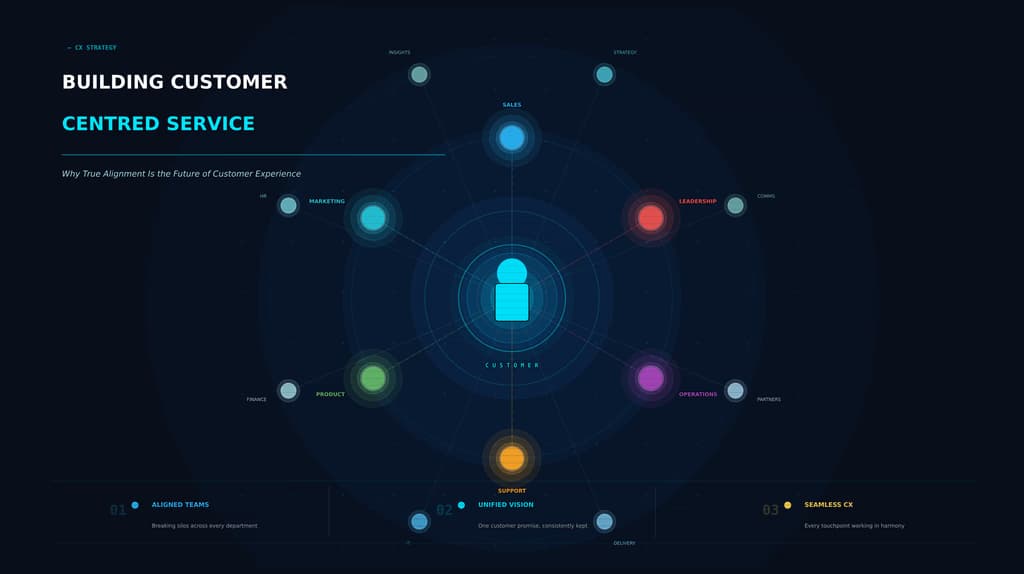
Building Customer Centred Service: Why True Alignment Is the Future of Customer Experience
20 February 2026

South Africa Has Emerged as a Global Leader in Business Process Outsourcing
18 February 2026